EIN Application
- Enrolled Agents licensed to practice before the IRS
- English and Spanish
- Since 2009 · 17+ years combined
- Free 30-minute consultation

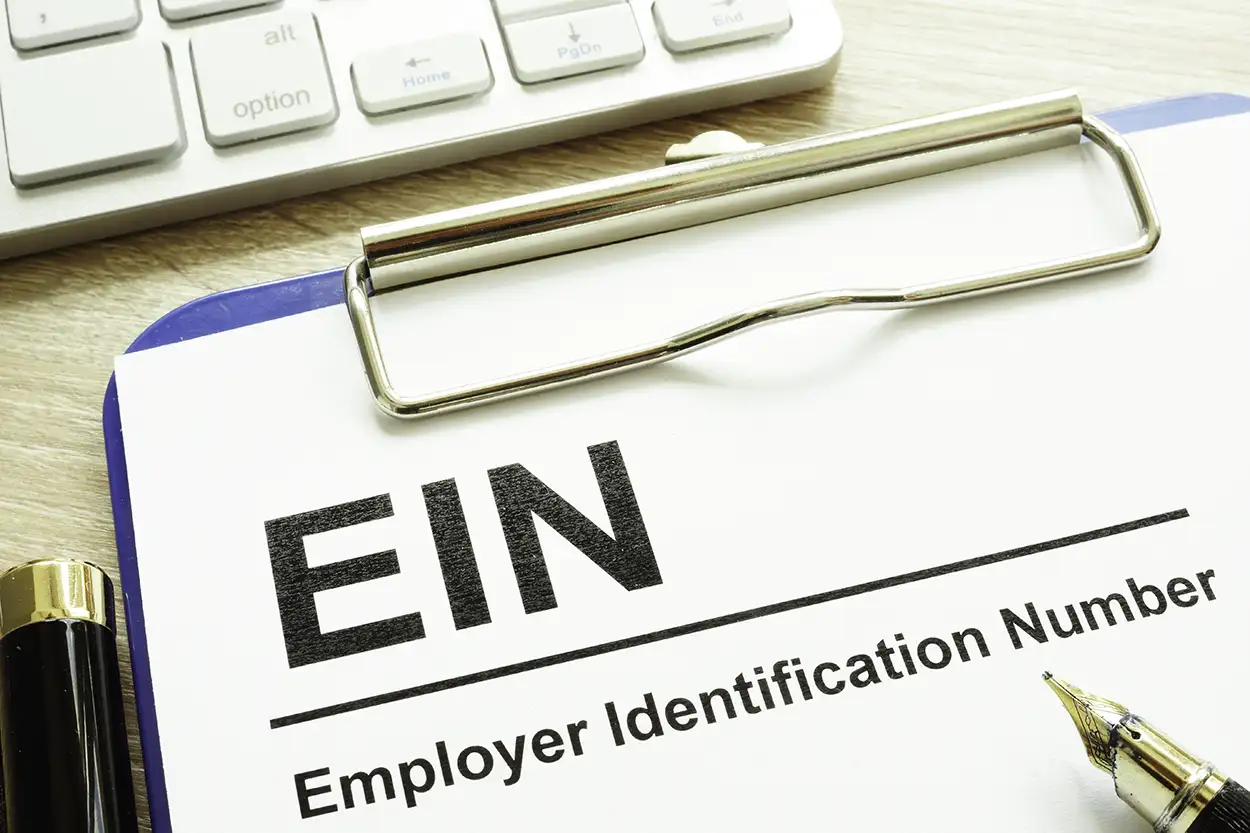
An EIN is the nine-digit federal tax ID the IRS uses to identify your business, the way a Social Security number identifies a person. We prepare and file the EIN application for Florida businesses from our Coral Springs office, in English or Spanish: Form SS-4, the entity classification behind it, and the one line that decides whether it clears.
First, the part most sites selling this leave out. The number itself is free. The IRS says it plainly: "Beware of websites that charge for an EIN. You never have to pay a fee for an EIN." (IRS, Get an employer identification number). What you pay a professional for is getting the entity type and the responsible party right the first time — not the number.
Who actually needs one
Not every business does. You need an EIN if you have employees, if you will owe employment or excise taxes, or if you withhold tax on non-wage income paid to a nonresident alien. Corporations, partnerships and multi-member LLCs need one in order to file at all. A one-owner business often does not: "a sole proprietor should file only one Form SS-4 and needs only one EIN, regardless of the number of businesses operated as a sole proprietorship or trade names under which a business operates. However, if a sole proprietorship incorporates or enters into a partnership, a new EIN is required" (Instructions for Form SS-4, Rev. December 2025). Opening a bank account is a recognized reason to apply, not an IRS requirement: Form SS-4 pairs "opened a bank account" with "needs an EIN for banking purposes only" among the reasons for filing (Form SS-4, Do I Need an EIN?). Whether a bank insists on one is that bank's own policy — a sole proprietor can often open a business account with an SSN.
What an EIN application in Florida turns on: the responsible party
Form SS-4 asks who controls the entity, and the IRS means something exact: "The 'responsible party' is the person who ultimately owns or controls the entity or who exercises ultimate effective control over the entity." Two rules follow from it, and both catch people out:
- It has to be a human being. "Unless the applicant is a government entity, the responsible party must be an individual (that is, a natural person), not an entity." A parent company cannot be the responsible party for its own subsidiary.
- One EIN per responsible party, per day. "EIN issuances are limited to one per responsible party, per day", and the limit "is applicable to all requests for EINs whether online, telephone, fax, or mail." The cap is per responsible party, not per entity: three entities with the same responsible party means three days, however you file them, while three entities with three different responsible parties can all be issued the same day. For trusts the limit "is applied to the grantor, owner, or trustor"; for estates, "to the decedent (decedent estate) or the debtor (bankruptcy estate)."
It does not end when the number arrives, either. Any entity with an EIN "is required to report a change in its 'responsible party' on lines 8 and 9 within 60 days of the change", on Form 8822-B. Skipping that is how an IRS notice ends up at an old address, unopened.
If the responsible party is foreign or has no SSN
Two separate rules govern the online tool, and neither one is triggered merely by not having an SSN. The first is about identification: the principal officer, general partner, grantor or owner "must have a valid taxpayer identification number (SSN, EIN, or ITIN) in order to use the online application" — so a responsible party who holds an ITIN and no SSN can still apply online. The second is about location: "If you have NO legal residence, principal place of business, or principal office or agency in the United States or U.S. territories, you can't use the online application to obtain an EIN." A Florida company has its principal place of business here, so that second rule does not close the online route for it — and by the same test the telephone channel is not open to it either, since "The IRS no longer issues EINs by telephone for domestic taxpayers." What does close the online route is a responsible party with no SSN, EIN or ITIN at all; that application goes by fax or mail. On the form you "Enter 'foreign' or N/A on line 7b if the responsible party doesn't have and is ineligible to obtain an SSN or ITIN."
Read that word: ineligible. If you are required to file a U.S. return yourself — as a partner, or on Florida rental income — you are not ineligible; you need an ITIN first. We file those as an IRS Certifying Acceptance Agent, so your passport stays with you.
How long each route takes
- Online: assigned in the same session, if you qualify to use it.
- Fax: "you can receive your EIN by fax generally within 4 business days."
- Mail: "approximately 4 weeks" — and the IRS asks you to send Form SS-4 "at least 4 to 5 weeks before you will need an EIN."
If a filing deadline lands first, there is a fallback: "If you don't have an EIN by the time a return is due, write 'Applied For' and the date you applied in the space shown for the number."
What the number opens once you have it
In Florida the EIN also feeds the state registration — for the entities that are required to have one. The Florida Business Tax Application covers "over 30 taxes and fees", Sales Tax among them, and the instructions say the IRS "requires any business that has employees and any partnership, corporation, nonprofit organization, trust (except certain revocable trusts), and estate to have a federal employer identification number (FEIN). You will need this number to register with the Department." The line immediately after it is the one that covers most owners who walk in here: "If you are a sole proprietor (individual business owner) or an individual who is the sole member of a limited liability company, you will need your social security number (SSN) to register with the Department" (Registering Your Business, DR-1N, R. 01/26). So the EIN is what payroll and your first corporate tax return will ask for, but a one-owner business may well register with the state on its SSN alone. If the company itself does not exist yet, we work in a set order — incorporating in Florida first, then the EIN, then the state registration. That sequence is our practice rather than a rule either agency imposes; it keeps the names and classifications matching, and we do the three in one pass.
File your EIN application with an Enrolled Agent
Bring your formation documents and the owner's ID and we will complete Form SS-4 with you — or tell you honestly that you do not need one. The IRS publishes the form in Spanish as well, as Form SS-4 (sp), and we work in both languages. We are at 1700 N University Dr STE 210, Coral Springs, and the first consultation is free.
global financial solutions
What to expect from accounting Max Services?

One-on-one expert support
Powerful financial reporting